Earthquakes are among the most unpredictable natural disasters, capable of causing severe damage to buildings and infrastructure within seconds. While no structure can be made completely earthquake-proof, modern engineering techniques and high-quality construction materials can significantly reduce the risk of collapse and protect lives. One of the most critical elements in earthquake-resistant construction is the choice of reinforcement steel.
Today, engineers and builders place great emphasis on selecting earthquake resistant TMT bars that can withstand the intense forces generated during seismic activity. Unlike conventional steel bars, advanced TMT bars are designed to provide a unique balance of strength and flexibility, allowing structures to absorb and dissipate earthquake energy instead of failing suddenly.
For homeowners, builders, architects, and developers, understanding the role of ductility in reinforcement steel is essential when constructing in earthquake-prone areas. In this article, Shirdi TMT explains why ductility matters, how seismic-resistant TMT bars improve structural safety, and what you should consider when selecting steel for your next construction project.
Why Earthquakes Put Buildings Under Extreme Stress
During an earthquake, the ground does not simply move up and down. It shakes in multiple directions, creating powerful horizontal and vertical forces on buildings. These rapid movements cause continuous compression, tension, bending, and twisting throughout the structure.
Concrete performs exceptionally well under compression but is relatively weak in tension. This is why reinforced concrete relies on steel bars to absorb tensile forces. If the reinforcement steel lacks flexibility, it can fracture under sudden seismic loads, increasing the risk of structural failure.
This is where seismic zone steel bars play a vital role. High-quality TMT bars with superior ductility allow reinforced concrete structures to deform without collapsing, giving occupants valuable time to evacuate safely.
Understanding Ductility in Steel
One of the most important mechanical properties of reinforcement steel is ductility in steel.
Ductility refers to the ability of steel to stretch, bend, and deform under stress without breaking. In simple terms, a ductile TMT bar can absorb large amounts of energy before failure.
Imagine trying to bend two different metal rods. One bends gradually without breaking, while the other snaps almost immediately. The first rod is more ductile, and this is exactly the characteristic engineers seek for earthquake-resistant construction.
When seismic forces strike a building, ductile reinforcement allows structural members to flex and redistribute loads instead of developing sudden brittle fractures.
This flexibility makes a significant difference in reducing structural damage during earthquakes.
Why Strength Alone Is Not Enough
Many people assume that stronger steel automatically offers better earthquake protection. While strength is important, it is only one part of the equation.
A steel bar with very high strength but poor ductility may resist heavy loads during normal conditions but fail suddenly during an earthquake.
Earthquake-resistant design requires a careful balance between:
- High yield strength
- Excellent ductility
- Good weldability
- High fatigue resistance
- Superior elongation
- Consistent mechanical properties
This balance allows the structure to withstand repeated cycles of loading and unloading without catastrophic failure.
That is why engineers increasingly recommend high-ductility grades such as Fe-500D and Fe-550D for projects located in seismic regions.
What Is Elongation Percentage?
Another key factor that determines seismic performance is elongation percentage.
Elongation measures how much a steel bar can stretch before breaking. It is expressed as a percentage of the original length.
For example, if a steel bar stretches significantly before failure, it has a higher elongation percentage.
Higher elongation provides several important advantages:
- Better energy absorption
- Improved flexibility
- Lower risk of brittle failure
- Greater crack resistance
- Better performance during repeated seismic loading
This property works together with ductility to improve the overall resilience of reinforced concrete structures.
How Earthquake-Resistant TMT Bars Improve Structural Safety
Modern earthquake resistant TMT bars are manufactured using advanced thermo-mechanical treatment processes that create a unique microstructure.
The outer layer becomes extremely strong, while the inner core remains softer and more ductile.
This combination offers several structural benefits.
Better Energy Absorption
During an earthquake, buildings experience repeated cycles of loading and unloading. Ductile steel absorbs this energy, reducing stress concentration within the structure.
Reduced Risk of Sudden Collapse
Instead of snapping under extreme loads, ductile TMT bars deform gradually, giving the structure additional stability.
Improved Crack Control
Flexible reinforcement distributes stresses more evenly, helping minimize crack formation in concrete.
Higher Fatigue Resistance
Repeated vibrations and cyclic loading can weaken ordinary reinforcement over time. High-quality TMT bars are designed to withstand these repeated stresses.
Longer Structural Life
Reduced cracking and better stress distribution contribute to improved durability and lower maintenance requirements.
Understanding Seismic Building Codes in India
India has several earthquake-prone regions, making seismic design an important part of modern construction.
The Bureau of Indian Standards (BIS) has established seismic building codes India through IS 1893 and IS 13920, which provide guidelines for designing earthquake-resistant structures.
These standards recommend construction practices that improve building performance during seismic events, including:
- Proper reinforcement detailing
- Adequate anchorage lengths
- Ductile reinforcement
- Correct beam-column joint design
- Controlled structural deformation
While following these codes alone cannot eliminate earthquake damage, they significantly improve the safety of buildings when combined with high-quality TMT bars.
Why Fe-500D Is Preferred in Seismic Zones
Among the commonly available reinforcement grades, Fe-500D has become one of the preferred choices for earthquake-resistant construction.
Although Fe-500 and Fe-500D have similar yield strength, Fe-500D offers considerably better ductility and elongation.
Its advantages include:
- Higher flexibility
- Better bendability
- Superior weldability
- Improved fatigue resistance
- Higher elongation percentage
- Better energy absorption
These properties enable buildings to respond more effectively to sudden seismic forces.
For residential, commercial, and institutional projects located in earthquake-prone areas, engineers often recommend Fe-500D because it provides an excellent balance between strength and structural flexibility.
Applications of Earthquake-Resistant TMT Bars
High-ductility reinforcement is suitable for a wide variety of construction projects.
These include:
Residential Buildings
Homes located in seismic regions benefit from reinforcement capable of absorbing earthquake energy without sudden failure.
High-Rise Buildings
Tall buildings experience greater lateral movement during earthquakes, making ductile reinforcement especially important.
Commercial Complexes
Shopping malls, office buildings, and mixed-use developments require reinforcement that maintains structural integrity during seismic events.
Hospitals
Healthcare facilities must remain operational after earthquakes, making structural resilience a top priority.
Schools and Educational Institutions
Protecting students and staff requires reliable structural reinforcement that complies with seismic design principles.
Bridges and Infrastructure
Bridges experience dynamic loading even under normal traffic conditions. Earthquake-resistant reinforcement further enhances their safety during seismic activity.
Other Factors That Influence Earthquake Resistance
Selecting high-quality TMT bars is only one part of earthquake-resistant construction.
Other critical factors include:
Quality Concrete
Concrete must achieve the required compressive strength to work effectively with reinforcement steel.
Proper Structural Design
Experienced structural engineers design buildings that distribute seismic forces safely.
Correct Reinforcement Detailing
Proper bar spacing, anchorage, overlaps, and beam-column reinforcement improve structural performance.
Skilled Construction Practices
Even the highest-quality materials cannot compensate for poor workmanship or improper construction techniques.
Quality-Controlled Materials
Using certified reinforcement from trusted manufacturers ensures consistent mechanical properties throughout the project.
Why Manufacturing Quality Matters
Not all TMT bars marketed under the same grade offer identical performance.
Premium manufacturers maintain strict quality control at every stage of production, including:
- Chemical composition testing
- Mechanical property verification
- Tensile strength testing
- Yield strength testing
- Bend and rebend tests
- Dimensional accuracy checks
At Shirdi TMT, every TMT bar is manufactured using advanced thermo-mechanical treatment technology and undergoes rigorous quality inspections to ensure dependable performance. Our commitment to consistency helps engineers, contractors, and homeowners build safer, stronger, and more durable structures that meet modern construction standards.
Choosing the Right TMT Bars for Seismic Zones
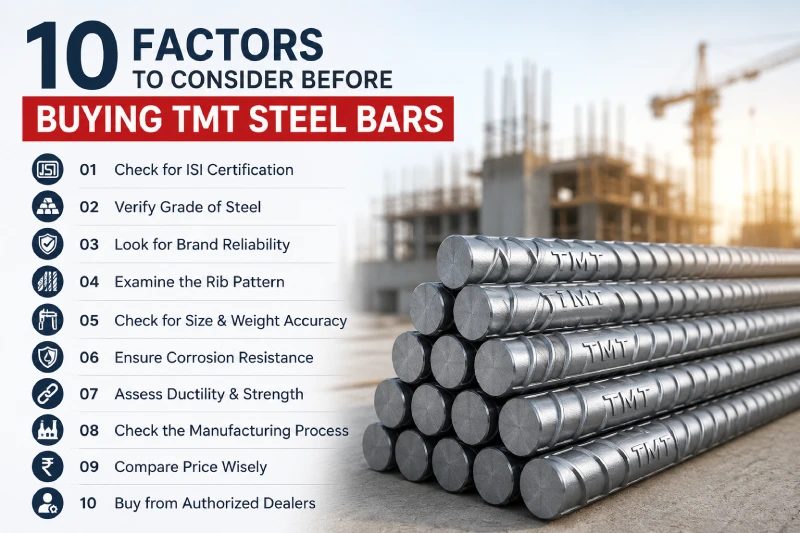
When selecting reinforcement for earthquake-prone areas, consider the following:
- Choose certified TMT bars from trusted manufacturers.
- Prefer high-ductility grades such as Fe-500D or Fe-550D where recommended by structural engineers.
- Ensure compliance with applicable Indian standards.
- Verify mechanical properties, including yield strength and elongation.
- Avoid compromising on quality to reduce construction costs.
- Always follow the recommendations of qualified structural consultants.
Investing in superior reinforcement at the construction stage can prevent expensive repairs and significantly improve the building’s ability to withstand seismic forces.
Conclusion
Earthquakes cannot be prevented, but their impact on buildings can be greatly reduced through intelligent design and the use of high-quality construction materials. Choosing earthquake resistant TMT bars is one of the most important decisions for ensuring long-term structural safety.
The combination of strength, ductility in steel, high elongation percentage, and compliance with seismic building codes India allows modern TMT bars to absorb seismic energy, reduce cracking, and improve the overall resilience of reinforced concrete structures. These qualities make seismic zone steel bars an essential component of safe construction in earthquake-prone regions.
At Shirdi TMT, we are committed to manufacturing premium-quality TMT bars that deliver exceptional strength, flexibility, and reliability. Whether you are constructing a residential home, commercial complex, industrial facility, or infrastructure project, our advanced reinforcement solutions are engineered to support superior structural safety reinforcement and provide lasting confidence for every build.