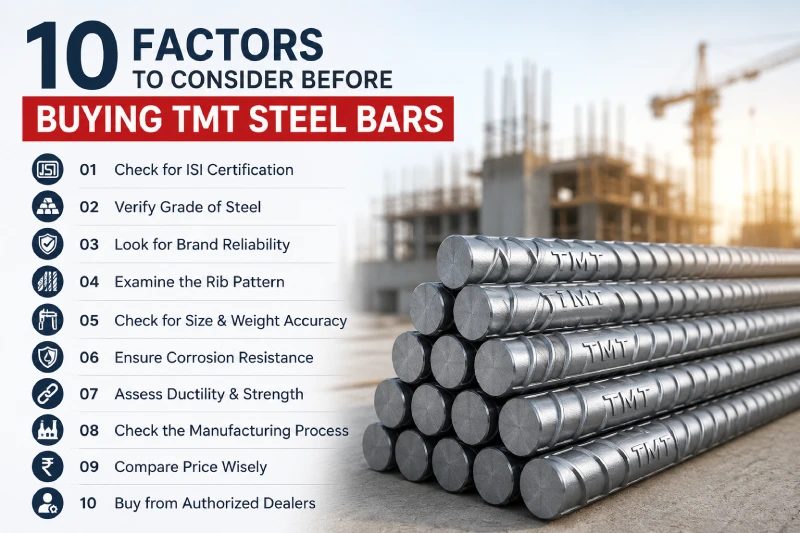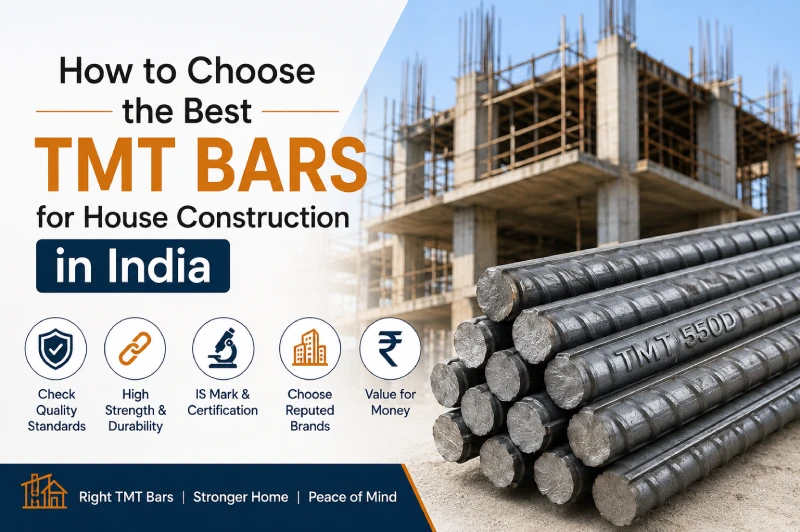
When planning any construction project, one of the most important decisions is selecting the right steel reinforcement. Whether you’re building a home, commercial complex, industrial unit, or infrastructure project, the quality and grade of your TMT bars directly influence the strength, durability, and safety of the structure.
Many buyers come across terms like Fe-500, Fe-500D, and Fe-550D but are often unsure about what these grades actually mean. Does a higher number automatically mean better quality? Is Fe-550D always the best choice? Or is Fe-500 sufficient for residential construction?
Understanding the fe-500 vs fe-500d vs fe-550d comparison helps builders, contractors, engineers, and homeowners make informed decisions without overspending or compromising on structural safety.
In this guide, Shirdi TMT explains the differences between these popular TMT bar grades, their mechanical properties, applications, and how to choose the right one for your project.
Understanding TMT Bar Grades
The “Fe” in a TMT bar grade stands for iron (Ferrum), while the number represents the minimum yield strength measured in N/mm² (Newton per square millimetre).
For example:
- Fe-500 = Minimum yield strength of 500 N/mm²
- Fe-550D = Minimum yield strength of 550 N/mm²
The suffix “D” stands for high ductility. While both Fe-500 and Fe-500D have the same minimum yield strength, the “D” grade offers greater elongation, improved flexibility, and enhanced resistance during seismic activity.
Understanding this N/mm² steel rating is essential because it tells you how much stress the steel can withstand before permanent deformation occurs.
What is Fe-500 TMT Bar?
Fe-500 has been one of India’s most commonly used reinforcement grades for many years.
It offers an excellent balance between strength and affordability, making it suitable for a wide range of residential and commercial projects.
Key Features
- Yield strength of 500 N/mm²
- Good tensile strength
- Cost-effective option
- Suitable for RCC structures
- Reliable performance under normal loading conditions
Best Applications
- Residential homes
- Apartment buildings
- Small commercial buildings
- Boundary walls
- General construction projects
For projects located in areas with moderate environmental conditions and standard structural requirements, Fe-500 continues to be a dependable choice.
What is Fe-500D TMT Bar?
Although Fe-500D has the same yield strength as Fe-500, it is manufactured to achieve significantly higher ductility.
This means the steel can stretch more before breaking, allowing it to absorb greater energy during earthquakes, heavy loads, or sudden structural movement.
Key Features
- Yield strength of 500 N/mm²
- Higher elongation
- Better weldability
- Improved fatigue resistance
- Superior bendability
- Better earthquake performance
The additional ductility makes Fe-500D particularly valuable in modern construction where structural flexibility is just as important as strength.
What is Fe-550D TMT Bar?
Fe-550D combines higher strength with high ductility, making it one of the preferred grades for demanding structural applications.
It provides greater load-bearing capacity without sacrificing flexibility.
Key Features
- Yield strength of 550 N/mm²
- High tensile strength
- Excellent ductility
- Better crack resistance
- Higher structural efficiency
- Suitable for heavy-load applications
This grade is widely used in large commercial developments and infrastructure projects where structural performance is critical.
Fe-500 vs Fe-500D vs Fe-550D: Complete Comparison
Let’s understand the tmt bar grades comparison through their major properties.
| Property | Fe-500 | Fe-500D | Fe-550D |
| Minimum Yield Strength | 500 N/mm² | 500 N/mm² | 550 N/mm² |
| Ductility | Moderate | High | High |
| Elongation | Lower | Higher | High |
| Weldability | Good | Better | Excellent |
| Earthquake Resistance | Good | Very Good | Excellent |
| Suitable for Heavy Loads | Moderate | Good | Excellent |
| Best For | Homes | Residential & Commercial | High-rise & Infrastructure |
This comparison clearly shows that choosing a higher grade is not simply about strength—it also depends on flexibility, safety, and project requirements.
Tensile Strength Comparison
One of the most misunderstood aspects of reinforcement steel is tensile strength.
Yield strength indicates when steel starts deforming permanently, while tensile strength refers to the maximum stress it can withstand before failure.
In any tensile strength comparison, Fe-550D performs better because of its higher strength and superior manufacturing process.
However, higher tensile strength alone is not enough.
Engineers also evaluate:
- Yield strength
- Tensile strength
- Elongation
- Weldability
- Fatigue resistance
- Ductility
The ideal TMT bar strikes a balance among all these properties rather than excelling in just one.
Ductility vs Strength: Which Matters More?
A common misconception is that stronger steel is always better.
In reality, ductility vs strength is one of the most important considerations in structural engineering.
Strength
Strength determines how much load a bar can safely carry.
Higher strength allows thinner sections and supports heavier structures.
Ductility
Ductility determines how much the steel can deform before failure.
Highly ductile steel:
- Absorbs seismic energy
- Prevents sudden collapse
- Reduces cracking
- Improves structural safety
- Performs better during dynamic loading
For earthquake-prone regions or multi-storey buildings, ductility becomes extremely important.
This is why many structural engineers now prefer Fe-500D or Fe-550D over conventional Fe-500.
Which Grade is Best for Residential Construction?
For most homes, choosing between these grades depends on the design and future expansion plans.
Choose Fe-500 if:
- You’re building a standard single-family home
- Budget is the primary concern
- Structural loads are moderate
- Construction follows standard engineering practices
Choose Fe-500D if:
- Your home is located in a seismic zone
- You want greater safety
- The structure has multiple floors
- Long-term durability is a priority
Many engineers today recommend Fe-500D because the additional ductility provides an extra margin of safety without a significant increase in cost.
When Should You Choose Fe-550D?
Fe-550D is ideal for projects requiring higher structural performance.
These include:
- High-rise buildings
- Commercial complexes
- Industrial buildings
- Bridges
- Flyovers
- Large warehouses
- Institutional buildings
- Infrastructure projects
Its higher load-bearing capacity allows engineers greater flexibility in structural design while maintaining safety.
Factors to Consider Before Selecting a TMT Grade
Rather than choosing solely based on the grade number, consider the following factors:
Building Type
Residential homes have different reinforcement requirements than commercial or industrial buildings.
Structural Design
The structural engineer’s calculations should always determine the appropriate grade.
Earthquake Zone
Projects in seismic regions benefit from higher ductility grades like Fe-500D and Fe-550D.
Load Requirements
Higher loads demand stronger reinforcement.
Budget
Using unnecessarily high-grade steel may increase costs without adding practical value for smaller structures.
Future Expansion
If additional floors are planned in the future, selecting the appropriate grade during initial construction can provide better structural flexibilit
Why Quality Matters More Than Grade Alone
Selecting Fe-550D from an unreliable manufacturer may perform worse than using certified Fe-500D from a trusted brand.
High-quality TMT bars undergo strict quality control for:
- Chemical composition
- Mechanical properties
- Rib design
- Dimensional accuracy
- Corrosion resistance
- Manufacturing consistency
At Shirdi TMT, every bar is produced using advanced manufacturing processes and rigorous quality testing to ensure consistent performance across every batch. This gives builders and engineers confidence that the steel delivered meets the required standards for strength, ductility, and long-term durability.
The Right Choice Depends on Your Project
There is no universal answer to which grade is “best.”
- Fe-500 is an economical and dependable option for standard residential construction.
- Fe-500D offers the same strength with significantly better ductility, making it an excellent choice for modern homes and commercial buildings.
- Fe-550D delivers higher strength along with excellent ductility, making it ideal for high-load structures and infrastructure projects.
The right decision should always be based on structural design, engineering recommendations, site conditions, and long-term performance—not just the highest grade available.
Conclusion
Choosing between fe-500 vs fe-500d vs fe-550d involves much more than comparing numbers. Understanding tmt bar grades comparison, tensile strength comparison, ductility vs strength, and the importance of the N/mm² steel rating enables builders and property owners to make smarter, safer investment decisions.
For most modern construction projects, ductility has become just as important as strength. Selecting the right TMT bar grade ensures better structural stability, improved earthquake resistance, longer service life, and greater peace of mind.
At Shirdi TMT, we are committed to manufacturing premium-quality TMT bars that meet stringent industry standards for strength, consistency, and durability. Whether you’re building your dream home or executing a large commercial project in Kolhapur or across Maharashtra, our team can help you choose the best TMT grade for construction based on your specific structural requirements.